Hey there, fellow business owner, marketer, or ambitious entrepreneur burning the midnight oil.
I see you. You’re sitting there with a million tabs open, a half-empty coffee cup that’s gone cold, and that familiar knot in your stomach. The one that asks, “Am I doing this right? Am I focusing on the right thing?”
The world of digital marketing is a noisy place. Everyone’s shouting about SEO, but nobody sits down with you to explain the roadmap. They throw jargon at you like confetti: “Optimize your meta descriptions!” “Get more citations!” “Build backlinks!” “Google Business Profile!”
It’s overwhelming. I get it.
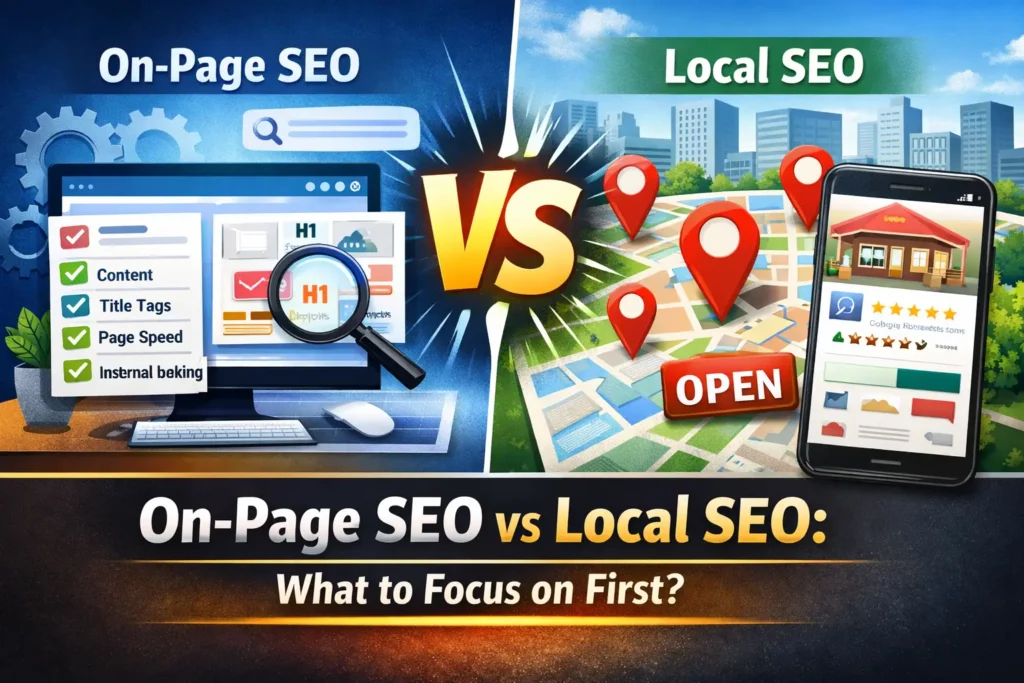
Today, we’re going to make it right. We’ll have an honest, open discussion about the two pillars which have the most impact on local business owners and content creators: On-Page SEO and Local SEO.
And we’ll solve the question that keeps you awake at midnight: “local seo vs on-page seo which to focus on first? “
Get yourself a fresh cup of coffee. Sit down. This will be the final guide you’ll ever need in this area.
Part One: The Foundation – Understanding the Battlefield
Before we can determine which areas to put our troops, it is important to know the terrain. Imagine Google as a huge extremely efficient librarian. Its role is to arrange all the information available and provide users with the solution they’re looking for.
Your task is to make your company the obvious, undisputed solution.
However, here’s the catch that a librarian (Google) analyzes two distinct types of evidence to determine whether your business is a suitable one for the searcher.
Chapter 1: What Is On-Page SEO? (Your Digital Identity)
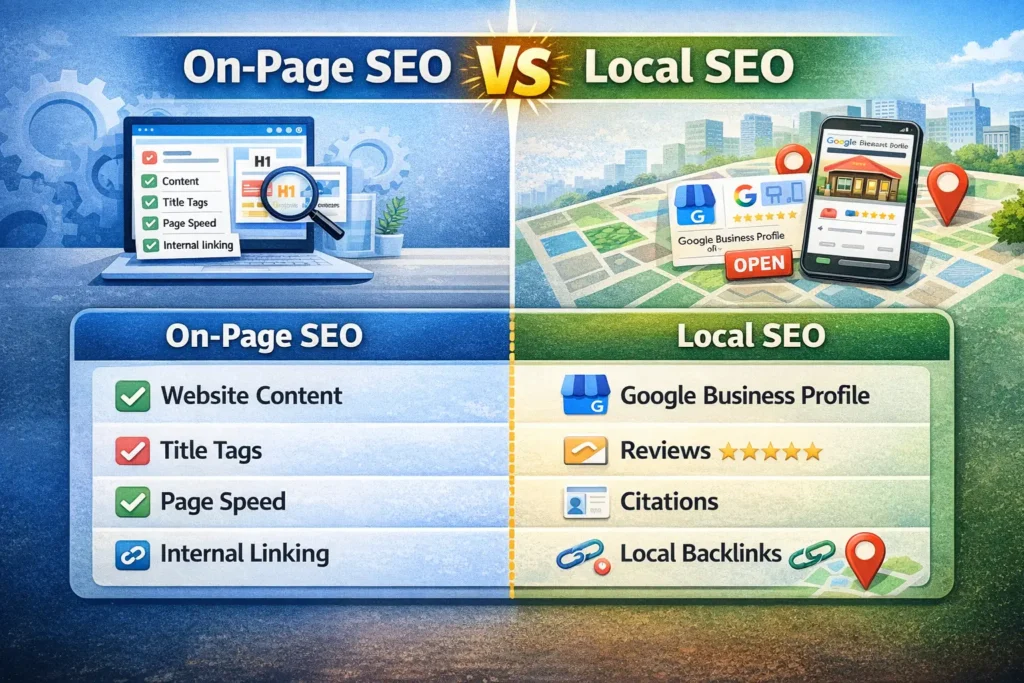
Let’s begin with On-Page SEO. If your site were the person, On-Page Search would encompass everything about the person’s knowledge, appearance, the credentials they have, their ability to clearly communicate.
SEO On-Page includes every element that you control on your site to increase your rank and generate more targeted visitors. This is the science and art behind creating a website that is attractive for both humans as well as search engine bots.
When Googlebot is crawling your site and asks a set of questions.
- What’s this page all about?
- Is the content high-quality and original?
- Does it answer the user’s query in a comprehensive manner?
- Does the site make it easy to navigate and is it easy to use?
- Does it load fast on a smartphone?
- Are they reliable and trustworthy?
On-Page SEO offers the solutions to these questions.
The Deep Dive: Every Element of On-Page SEO Explained
Let’s get granular. If you want to master this, you must be aware of the tools included in your toolbox.
- Content Quality and Keyword Strategy
This is the crux of the issue. Content isn’t simply words on a page, it’s the value. It’s the answer to the issue of your customer.
- Primary Keywords: These are your main targets. This keyword is found inside the H1 tag as well as naturally throughout the article.
- Secondary Keywords as well as Semantic relevance: Google is smart. It is aware of related concepts. Therefore, when we discuss “on-page seo vs local seo for small businesses,” Google recognizes that we’re within the same vicinity. Your content should naturally contain these phrases but without forcing these keywords.
- LSI Keywords (Latent Semantic Indexing): They are terms that have a conceptual connection. For On-Page SEO, this could include “meta tags,” “header structure,” “content optimization.” In the case of Local SEO, this could include “Google Maps,” “NAP consistency,” “local citations.” These signals should be added to Google.
- Content Intensity and Length: Studies consistently show that more detailed, longer content is more likely to rank higher. However, it’s not all about fluff, it’s about rigor. You must answer every question that the user might ask.
- Readability as well as user experience: Break up text using headers, bullet points, images and paragraphs that are short. The majority of people scan before reading. Let them do it easily.
- Title Tags (The Gateway Drug)
Your title tag is the clickable headline that appears in search results. It’s the first, and sometimes only, impression you get.
- Format: Primary Keyword | Brand Name (or reverse)
- Length: Keep it under 60 characters so it doesn’t get cut off.
- Power Moves: Use numbers, power words, and emotional triggers. “Ultimate Guide,” “Proven Strategies,” “2024 Update.”
- Meta Descriptions (The Free Ad Space)
Meta descriptions do not directly affect ranking, however they can dramatically affect the click through rates. Imagine them as a 155-character pitch to sell.
- What to Include: The primary keyword, a clear value proposition, and a call to action.
- Examples: “Torn between on-page seo vs local seo for small businesses? Discover exactly which strategy to prioritize first with our step-by-step roadmap for real results.”
- What’s the significance? More click-throughs indicate Google that your site’s results are relevant, which in turn can increase ranking.
- Header Tags (H1, H2, H3, H4) – Your Content Outline
Headers organize your content to appeal to both readers and search engines.
- H1 Tag: This is your main page title. You should use one for each page, and be sure to include your main keyword.
- H2 Tags: Major section headings. They break down your content into digestible chunks. They should contain secondary keywords and related phrases.
- H3 as well as H4 tags: Subsections under the H2s. They provide even more organisation.
- Best practice: Think of your headers as a comprehensive outline. If someone only reads your H2s and the H3s, they must be able to comprehend the complete structure in your arguments.
Well-structured content that directly answers user questions can even help you rank in featured snippets in SEO, where Google highlights clear, concise answers at the very top of search results.
- URL Structure (Clean and Descriptive)
Your URLs must be able to tell an interesting story.
- Good: yoursite.com/local-seo-vs-on-page-seo-guide
- Bad: yoursite.com/p=12345?category=blog&id=9876
- Best Tips: Use hyphens between words, make them brief but descriptive, and add your primary keyword whenever it is natural.
- Image Optimization (The Overlooked Goldmine)
Images not only make your content more interesting They also provide SEO benefits.
- File names: Do not leave them in the format of IMG_5923.jpg. Rename them descriptively: on-page-seo-vs-local-seo-infographic.jpg
- Alt text: It describes the picture for visually impaired people and informs Google what the image’s subject matter is. Include keywords when appropriate. “Diagram showing the relationship between on-page SEO elements and local SEO ranking factors.”
- Compression: The large size of images can cause slowdowns on your website. Utilize tools such as TinyPNG as well as ShortPixel in order to reduce images with no loss of quality.
- Internal Linking (Building Your Website’s Web)
Internal links link one part on your site with another.
- Why it is Important: They distribute “link juice” (ranking power) across your website and help Google to discover new pages and help keep your users on the site for longer.
- Strategy: Link from high-authority pages to more advanced or newer pages. Utilize an anchor description (the clicking words) which informs users and Google what the webpage is all about. For instance: “As we discussed in our guide to on-page seo vs local seo for beginners, the foundation matters most.”
- Page Speed (The Patience Killer)
In the age that is a constant flow of information speed is the most important factor. Google takes page speed as an important factor in ranking, particularly when it comes to mobile search.
- The impact: A one-second delay in loading time of a page could reduce conversions by 7 %.
- How to improve: Use caching plugins and optimize images, eliminate CSS and JavaScript as well as utilize a content delivery system (CDN). Test your speed using Google’s PageSpeedInsights.
- Mobile-Friendliness (Non-Negotiable)
More than 60% of all searches are conducted via mobile phones. Google utilizes mobile-first indexing, which means that it mostly makes use of the mobile version of your website to rank and indexing.
- Check Your Site: Use Google’s Mobile-Friendly Test.
- Design Responds: Your site should be able to adapt easily to any size screen.
- elements for touch: Links and buttons are designed to be easy for users to use without needing zoom.
- Schema Markup (Speaking Google’s Language)
Schema is a kind of microdata which helps search engines to understand the content of your website and show the most relevant results.
- Types of Schema: Article, Product, Review, Local Business, Event, FAQ, How-to.
- Benefits: Rich snippets can include star ratings, prices, author information, and event dates, making your listing stand out in search results.
- implementation: Make use of Google’s Structured data Markup Helper, or other plugins such as Yoast SEO as well as Rank Math.
- User Engagement Metrics (The Silent Signals)
Google monitors how visitors interact with your website.
- Bounce Ratio: Percentage of users who leave after having viewed just one page. An excessive bounce rate may suggest irrelevant content or an unsatisfactory user experience.
- Dwell Time What time the user remains on your website after clicking on search results. Longer dwell time signals valuable content.
- “Click-Through Rate” (CTR): The percentage of users who click your link upon seeing it. A higher CTR indicates to Google that your meta description is convincing.
Chapter 2: What Is Local SEO? (Your Neighborhood Reputation)
Now, let’s shift gears. If On-Page SEO concerns the identity of your website, Local SEO is about your business’s image and its presence in a certain geographical region.
Local SEO is a strategy employed to improve your exposure in local results of searches. This can include searches using “near me” modifiers, searches that focus on specific kinds of businesses within the area (like “Italian restaurant in ….”) as well as searches using Google Maps.
If someone is conducting an online search in a specific area, Google doesn’t just look at your site. It examines a variety of signals to prove that you’re a legitimate, trustworthy and well-known business in the area.
The Deep Dive: Every Element of Local SEO Explained
- Google Business Profile (The Absolute King)
The details of your Google Business Profile (GBP) is not negotiable. It’s the most crucial aspect of local SEO. When people search for companies like yours, a “Local Pack” (the map that has three listings) appears over organic results. Your GBP is the determining factor for whether you’re a part of the pack.
Optimizing Your GBP:
- Claim and verify: This is step one. Google will mail you a card or confirm via email or phone.
- Full Each Field: Business name address, telephone number, address website, category features (like “wheelchair accessible” or “free Wi-Fi”), products, services and descriptions.
- Photos and videos: Businesses with photos get 42 percent more requests for directions, and an increase of 35% in clicks on their websites. Update your photos every week: interior exterior, team, menu items, products.
- Posts Utilize”Posts” to share your information “Posts” feature to post updates, offers, events, blog posts. These are displayed in your profile and help keep your profile updated.
- Question and Answer: Monitor and answer questions. You can even prepare common questions and answer them on your own.
- Service and Products: List what you offer, including price and descriptions. This transforms your GBP into an online catalog.
- Online Reviews (Your Digital Word of Mouth)
Reviews are social evidence. They affect potential customers as well as Google’s algorithm.
- Quantity and Velocity: An ongoing stream of new reviews indicates an active, well-known business.
- Quality and Diversity: A mix of 5 and 4 star reviews with detailed content is the best way to go. React to all reviews, thank for positive reviews and respond to negative reviews professionally and constructively.
- Review platforms: Although Google reviews are the most significant, you should also keep an eye on Yelp, Facebook, industry-specific websites (like Healthgrades for doctors or Avvo for lawyers) as well as BBB.
- Local Citations (NAP Consistency)
Citations are any online reference to your company’s Name Address, Phone number (NAP). They can appear listed on directories that are major (Yelp, YellowPages, Bing Places) local directories (Chamber of Commerce local news websites) as well as directories that are niche (industry-specific websites).
The golden rule: your NAP should be 100% consistent across the internet. If your address reads “123 Main St.” on one website, but “123 Main Street” on another, it can confuse Google and can damage your credibility.
- Audit Your Citations: Utilize tools such as Moz Local, BrightLocal, or Whitespark to identify and correct any inconsistencies.
- Prioritize the Key Platforms: Verify that your NAP is accurate in Google, Apple Maps, Facebook, Yelp, Bing and the leading directories for your field.
- Localized Content (Speaking to Your Neighbors)
Your website’s content must reflect the locality of your site. This is more than just the city’s name.
- Design Location Pages: When you are serving several cities, you should create distinctive, high-quality websites for each. Do not just copy and paste names of cities. Add local information, reviews from the area as well as relevant information.
- Write blog posts for local blogs: Cover local events and news or concerns in your industry. “How to Prepare Your …. Home for Polar Vortex Season” or “Best Hiking Trails Near …. for Fall Colors.”
- include local landmarks and references: “We’re located just …..”
- Local Link Building (Earning Neighborhood Credibility)
Links from other local sites indicate Google Google that you’re a part of the community.
- Event and Sponsorship: Sponsor a local minor league team or a charity event. It is common to receive the link on their website.
- Local business Associations: Join your Chamber of Commerce or local business association. They usually have member directories that include hyperlinks.
- Collaborations: Partner with complementary local businesses for events or promotions. You can feature each other on your websites.
- Guest blogging: Write for local blogs, news sites, or community publications.
- Awards: Create a small grant to local high school students. .edu Links are extremely effective.
- Local Schema Markup (Structured Data for Local)
Local business schema helps Google display your information in rich results.
- What to Include: Business type, address, phone, hours, payment methods, price range, reviews, and geo-coordinates.
- implementation: Add this to your website’s HTML code, most preferably for your contact pages as well as every location page. Plugins such Yoast Local SEO can simplify this.
- Proximity to the Searcher (The X-Factor)
This is the only thing that you aren’t able to control directly. Google examines the physical distance between the user and your company. This is the reason why rankings are typically different for those looking in the …. area compared to someone who is from the ….. This is why having an address within or close to the city’s central area is beneficial.
Part Two: The Showdown – Making the Choice
Now we arrive at the heart of the matter. We’ve identified both candidates. We know their strengths. However, the question is: “local seo vs on-page seo which to focus on first? “
The answer, just like everything else in business is: It’s up to you. However, the majority of the time, it’s sequential.
Let me tell you an example.
Chapter 3: The Parable of Two Bakeries
Imagine two bakeries operating at the same time in the same place.
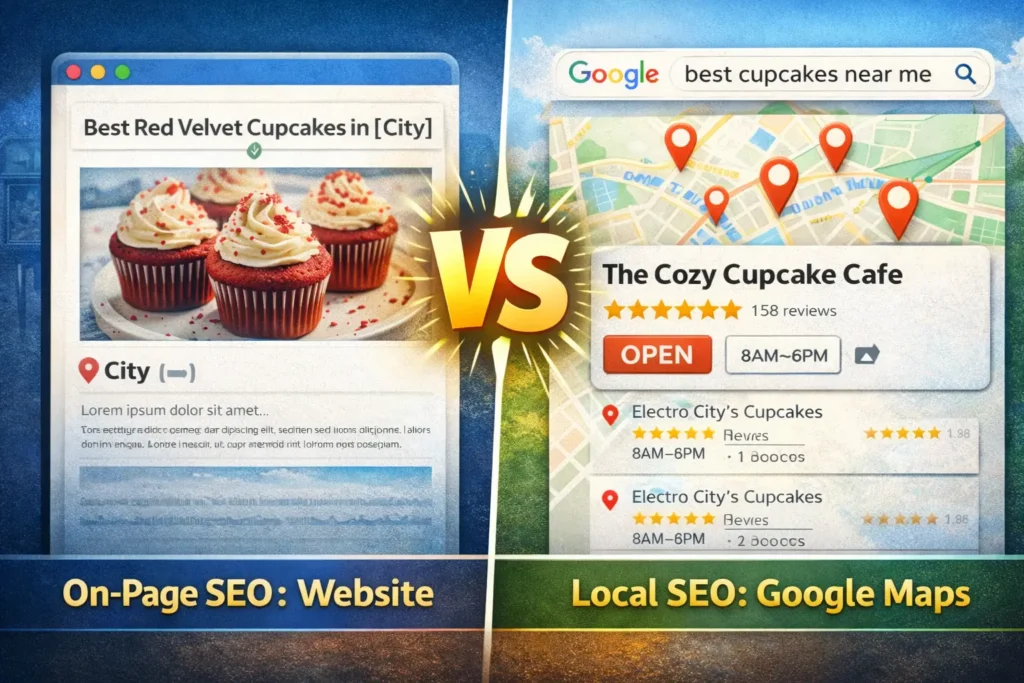
Bakery A is run by Sarah. Sarah is an excellent baker. Her croissants are flaky and perfect. Her sourdough bread has a perfect crust and the cupcakes she bakes are masterpieces of art. The first month she spends solely focused on local SEO. She creates a Google Business Profile, loads it with stunning images, gets 30 reviews from friends and relatives and creates citations on every directory she comes across.
The Google Business Profile looks amazing. People can see her in the Local Pack with 5 stars. They visit her website.
The website she has It’s… an absolute mess. It’s a basic template and loads slow. The menu is difficult to locate. The “Contact” page has the incorrect number. The pictures are blurry. There’s nothing to tell there’s no “About Us,” no idea about what Sarah is. Visitors click, become annoyed, and leave. They contact the other bakery instead.
Bakery B is run by Miguel. Miguel is also a fantastic cook, however he’s meticulous. The first month he spends solely focused on SEO for On-Page. He has built a stunning web page that loads quickly. He creates compelling content on the philosophy behind his cooking, sources of local ingredients and the background story behind his family’s recipe. Every page is optimised for each image, and each title tag. The site is enjoyable to explore.
He hasn’t updated the profile on Google Business Profile. He hasn’t requested one review. If people search in Google search results for “bakery near me,” it doesn’t show up within the Local Pack. It’s not visible to people who walk by his store in search of a pastry for breakfast.
Who will win?
Neither. It’s not yet.
Bakery A has visibility, but it’s a leaky bucket. They draw attention, but they can’t change their behavior.
Bakery B is a gorgeous storefront, but it’s hidden in an alleyway that is dark and has no signage. There is no one who knows about it.
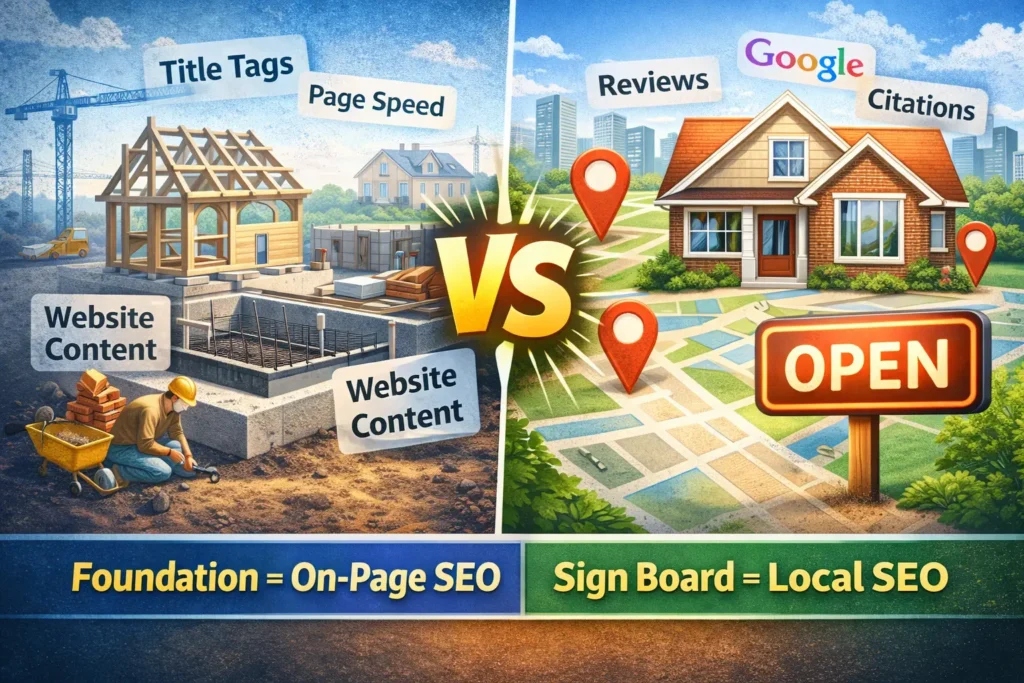
The winner is the bakery that builds the foundation first and then lights up the sign.
Chapter 4: The Framework – Foundation First, Visibility Second
Here is the proven, step-by-step framework for prioritizing your SEO efforts. This provides the answer to “local seo vs on-page seo which to focus on first” by providing an easy-to-follow action plan.
Phase One: The On-Page Foundation (Months 1-2)
Why first? Because On-Page SEO is 100% within your control. It’s your house that you construct. It’s the quality of your product. Without a strong home, inviting visitors is useless. They’ll notice the cracks and go away.
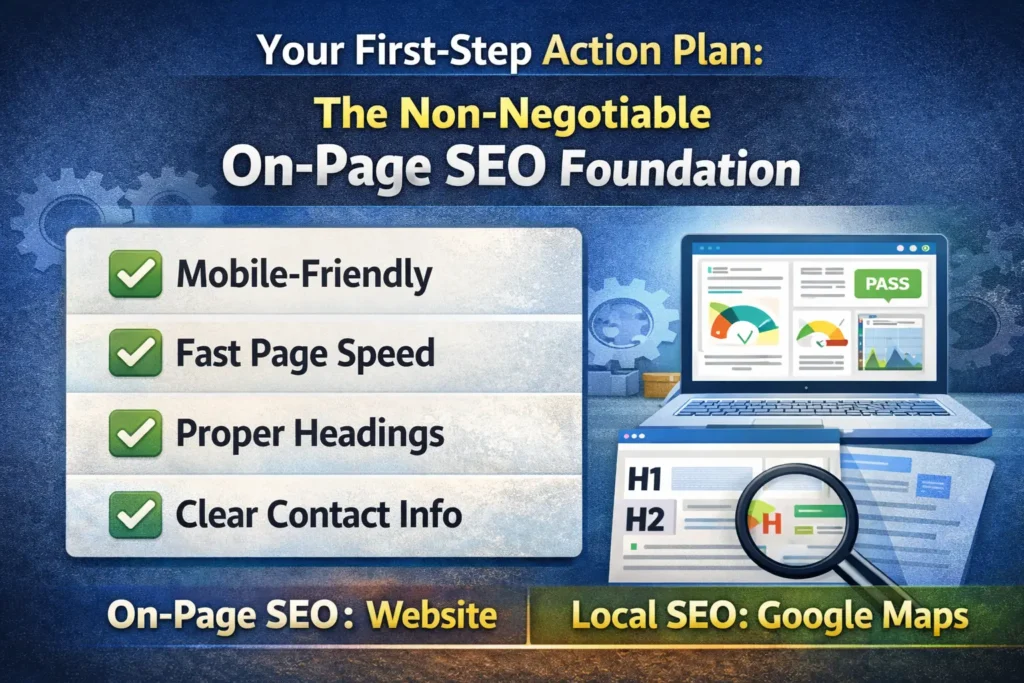
Your Non-Negotiable On-Page Foundation Checklist:
Week 1-2: Technical Audit and Fixes
- Test your website using Google PageSpeed Insights. Fix the most pressing issues.
- Use Google’s Mobile-Friendly Test. Ensure your site passes.
- Check for crawl errors in Google Search Console. Fix broken links and 404s.
- Make sure your website has the SSL certificate (HTTPS NOT HTTP). This is a ranking indicator as well as a trust signal.
- Submit your sitemaps via Google Search Console.
Week 3-4: Core Page Optimization
- Optimize your Homepage: Clear value proposition, primary keywords in title tag and H1, prominent call-to-action, and local modifier (city/region) if applicable.
- Optimize your About Us page: Tell your story, build trust, include keywords naturally, add photos of you and your team.
- Optimize your Contact page: Ensure NAP is prominently displayed, embed a Google Map, use a simple contact form.
- Optimize your Services/Products pages: For each service or product, create a dedicated page with detailed descriptions, benefits, pricing (if possible), and relevant keywords.
Week 5-6: Content and Structure
- Conduct keyword research. Find your primary, secondary and long-tail keywords.
- Create a content plan. Aim for at least 4-5 cornerstone pieces of content (blog posts, guides, videos) that comprehensively cover topics related to your business.
- Implement internal linking within your site. Link with related pages and blog posts.
- Optimize all images using descriptive names for the files along with alt-text.
Week 7-8: Schema and Final Polish
- Implement basic organization schema (or use an SEO plugin).
- If you are a business with a physical location, then you should implement a Local Business schema on your contact page.
- Review all title tags and meta descriptions. Make them compelling.
- Check your site’s performance on a variety of gadgets and web browsers.
By the end of Phase One, you have a website that:
- Fast loading on all devices.
- It is clear what you do and the reason you’re a good option.
- It is easy to use and navigate.
- It provides valuable information and answers customer queries.
- Technically optimized to allow spiders to crawl and index.
Your foundation is strong. Now is the time to show the world that you are there.
Phase Two: The Local SEO Amplification (Months 3-4+)
Now that your website is ready to convert visitors, we pour gasoline on the fire with Local SEO.
Your Local SEO Launch Checklist:
Week 9-10: Google Business Profile Domination
- Claim and confirm the authenticity of your Google Business Profile.
- Complete each and every field. Do not leave any blanks.
- Select the most relevant primary and secondary categories
- Write a compelling business description (750 characters) that includes your primary keywords and local modifiers.
- Include your hours, as well as the hours you have for holidays.
- Add attributes (women-led, veteran-led, free Wi-Fi, outdoor seating, etc. ).
- Upload 10 high-quality images of your interior, exterior products, team and menu.
- Add your own products or services along with prices and descriptions.
- Create a messaging system if you are able to respond quickly.
- Add a Q&A section and pre-populate it with common questions and answers.
Week 11-12: Review Generation System
- Create a simple process for asking customers for reviews. This could be a follow-up email, a text message, or a QR code on receipts.
- Create a direct link to your Google review page (use a tool like a Review Link Generator).
- Respond to ALL reviews currently being written (if there are any) professionally.
- Set a goal: Ask for 3-5 new reviews every week.
- Respond to every new review within 24-48 hours. Thank them, use their name, and be genuine.
Week 13-14: Citation Audit and Cleanup
- Utilize a tool like BrightLocal as well as Moz Local to scan for any existing references.
- Find inconsistencies in Your NAP across the internet.
- Create and optimize your profiles on the most important websites: Apple Maps, Facebook, Yelp, Bing Places, YellowPages, and industry-specific directories.
- Make sure your NAP is completely consistent across every platform.
Week 15-16: Local Content and Link Building
- Create your first piece of hyper-local content. Blog about a local event, sponsor a local team, or interview another local business owner.
- Reach out to local bloggers or news sites. Introduce yourself and offer value (a quote for a story, a collaboration idea).
- Get involved with your regional Chamber of Commerce or business association. Be listed through their web site.
- Find local sponsorship opportunities that offer the possibility of linking back to your website.
- Keep posting regularly to the Google Business Profile (photos, deals, and events).
By the end of Phase Two, you have:
- Fully designed and optimized Google Business Profile that dominates the Local Pack.
- A constant stream of good reviews, which builds social evidence.
- Consistent NAP information on the internet.
- Local content that shows your involvement in the community.
- The base for continued local exposure.
Part Three: The Nuances – When the Rules Bend
While the “Foundation First, Visibility Second” framework works for 90% of businesses, there are exceptions and nuances worth exploring.
Chapter 5: On-Page SEO vs Local SEO for Different Business Types
The balance can change based on the actions you take. This is where knowing “on-page seo vs local seo for small businesses” is crucial since the small business landscape is not alike.
Service Area Businesses (SABs): Plumbers, electricians, cleaners, mobile dog groomers.
- Priority: Local SEO is crucial because your company is local. Your website should be optimized for every city you provide (with distinct location pages). Your Google Business Profile should clearly mark that you serve customers at their locations, not at a physical address (if you don’t have one).
Brick-and-Mortar Retail/Restaurants: Coffee shops, boutiques, restaurants, gyms.
- Priority: Local SEO is everything. It is essential that people walk through your doors. The Google Business Profile hours, reviews, and photos are the difference between success and failure. On-Page SEO still matters for your menu, your story, and your branding.
E-commerce Businesses (Selling Nationwide/Globally): Online stores with no physical location.
- Priority: On-Page SEO is all you need. It’s not necessary to have Local SEO in any way (except the contact info page or perhaps the “about” page). Your focus is entirely on product pages, category pages, content marketing, and technical SEO.
Professional Service firms (with the office): Lawyers, architects, accountants and property agents.
- Priority: Both are equally vital.You need the Local SEO to attract clients in your city, but you need the On-Page SEO to demonstrate expertise and authority (E-E-A-T). Long-form content like guides and case studies builds trust for high-consideration services.
Multi-Location Business: Chains, franchises companies with multiple offices.
- Priority: A hybrid approach. You require a solid On-Page SEO base for your main site However, you will also require specific enhanced Google Business profiles as well as pages for every physical site. This requires a flexible strategy and careful handling.
Chapter 6: On-Page SEO or Local SEO – Which is Better for Beginners?
For those who are just beginning out, the query “on-page seo or local seo which is better” typically is a result with limited resources and time.
If you’re a novice with no web presence, here’s my suggestion:
Start With On-Page SEO to help you with your own personal education.
Here’s why: Learning On-Page SEO teaches you the fundamentals of how search engines think. You learn about keywords, content structure, user experience, and technical optimization. These abilities can be transferred. They help you become an effective marketer all-around.
Once you’ve mastered the fundamentals of On-Page SEO, implementing these to Local SEO will be much simpler. You’ll understand why your Google Business Profile description matters, why reviews are important, and why consistent NAP is crucial.
So, to answer the beginner’s question: Learn On-Page SEO first as your foundation, then apply that knowledge to dominate Local SEO. This is the definitive answer to “on-page seo vs local seo for beginners. “
Part Four: The Advanced Playbook – Synergy and Dominance
Once you have both On-Page and Local SEO in motion, the magic happens when they start working together. This is where you leave your competitors in the dust.
Chapter 7: The Convergence – Where On-Page Meets Local
Local businesses that are successful do not treat On-Page or Local SEO as separate silos. They seamlessly integrate them.
- Local Keywords in On-Page Content
This is the most obvious synergy. Your website content: blogs, service pages, guides. should be saturated with local keywords.
- Example: A dentist doesn’t only post on “teeth whitening.” The dentists write on “teeth whitening in ….,” “best teeth whitening for …. residents,” and “how …. coffee culture affects your teeth.”
- Location Pages: Design high-quality, dedicated pages to every neighborhood or city you serve. The pages should contain:
- Unique content on your products and services in that field.
- Testimonials of customers in that area.
- Embedded Google Map showing your service location.
- Local schema markups for the specific location.
- Photos of you serving customers in that area.
- Embedding Google Business Profile Content on Your Site
- Show your reviews: Display your latest Google reviews on your site with a review widget. This helps build trust right away.
- Embed your Google Map: On your contact page, embed a Google Map showing your exact address. This increases the local relevancy.
- Link to your Google Business Page: Add a prominent hyperlink to “See our Google Reviews” or “Find us on Google Maps” on your website.
- Using Your Website to Support Local Link Building
Your website’s content is the best way to get local hyperlinks.
- Create Linkable Assets: Write a comprehensive guide to your city (“The Ultimate Guide to a Weekend in [City Name]”). Local blogs, news sites, and visitors’ guides will link to it.
- Sponsorship Pages: If you sponsor an event locally, make a web page on it. Ask the event’s organizers to post a link to the page.
- Partner Spotlights: Write blog posts featuring other local businesses you collaborate with. They’ll often link back to you.
- Schema Markup That Bridges Both Worlds
- LocalBusiness Schema + Review Schema: Set up a LocalBusiness schema on both your location and contact pages. Within this schema, you can also include reviews from a variety of sources, including Google reviews. This could result in ratings that appear on your organic search results.
Chapter 8: Tracking and Measuring What Matters
It’s impossible to make improvements by measuring what you don’t know about. Unlocking the secrets of human behavior are the main metrics to monitor for both Local and On-Page SEO.
On-Page SEO Metrics:
- Organic Traffic: Number of visitors coming from search engines (Google Search Console, Google Analytics).
- Keyword Rankings: How you perform in your targeted keywords (tools such as SEMrush Ahrefs, SEMrush, and even manually-checks).
- Click-Through Rate (CTR): The percent of people who click on your page for the keywords you want to target (Google Search Console).
- Bounce Rate and Dwell Time: How engaged users are visiting your site (Google Analytics).
- Page Speed: Core Web Vitals scores (Google Search Console, PageSpeed Insights).
- Conversion Rate: The percentage of users who complete the desired action (form fill or call or even a purchase).
Local SEO Metrics:
- Google Business Profile Insights:
- Search Queries: What people searched for to find your listing.
- Views: How many times your listing was viewed on Search and Maps.
- Actions: Website clicks, direction requests, phone calls, messages.
- Photo Views: How often your photos are viewed compared to competitors.
- Local Pack Rankings: How you rank on your Local Pack for your key local terms (use local rank monitoring tools).
- Review Metrics: Number of new reviews, average rating, response rate.
- Citation Consistency: Percentage of citations that are accurate in NAP (use the tools to track citations).
Part Five: The Pitfalls – What to Avoid at All Costs
Let’s discuss landmines. The mistakes that can waste months of effort or even get you penalized.
Chapter 9: Common On-Page SEO Mistakes
- Keyword Stuffing
In the beginning days of SEO, you could repeat the keyword 100 times and get it to rank. These days are over. Keyword stuffing today renders your content difficult to read and could cause Google penalties. Write for human readers first, and search engines later. - Thin Content
Pages that contain only a few words (like one paragraph per service) are deemed to be of low value. Every page should contain complete details. If you have a page, make it worth visiting. - Duplicate Content
The copying of content on other sites, or even different pages of your website: confuses Google. It doesn’t know which site to be ranked on. Always make original content. For location pages, never simply copy and paste with a city name swap. - Ignoring Mobile Users
If your site isn’t mobile-friendly, you’re invisible to over half your potential customers. This is non-negotiable. - Broken Links
Links that redirect users to 404 error pages result in users with poor experience, and also waste “link juice.” Check your website regularly for broken links and repair the problem or redirect it. - Slow Loading Speed
We’ve already covered this previously, but it’s still worth mentioning. Slow websites can hurt rankings and leads to conversions.
Chapter 10: Common Local SEO Mistakes
- Inconsistent NAP Information
This is the #1 local SEO killer. If your address appears somewhat different in Yelp than it appears on Google, you’re compromising your credibility. Check and correct this issue immediately. - Neglecting Google Business Profile
In the event that you claim your profile, not utilizing it is a wasted opportunity. Post frequently, upload photos, reply to reviews and ensure that your hours are up to date. A profile that is active indicates an active business. - Fake Reviews
The purchase of fake reviews or asking family members and friends who aren’t customers in real life to leave reviews is a violation of Google’s guidelines. You could get your profile banned. Earn reviews legitimately. - Ignoring Negative Reviews
Everybody gets a negative review at some point. Neglecting it or defending yourself will make you appear bad. Be professional, apologize in public and offer an apology offline. This will show potential customers that you are concerned. - Using a P.O. Box for Your Address
Google is looking to confirm your physical address. If you’re a business in the service area with no storefront, conceal your address in GBP, and determine your service area. Using a P.O. Box could cause issues with verification. - Keyword Stuffing Your Business Name
Google’s guidelines prevent the addition of locations or keywords to your business’s name, if the names are not included in your registered name. “Miguel’s Bakery” should not be listed as “Miguel’s Bakery Best Cupcakes in …..” This can get your profile suspended.
Part Six: The Long Game – Sustainability and Growth
SEO isn’t a once-off project. It’s a continuous commitment. The companies that succeed are those who consistently invest in their online presence.
Chapter 11: The Ongoing Cycle of Optimization
Imagine all of your SEO actions as being a spinning flywheel and not a linear route.
The SEO Flywheel:
- Improve or Create: Publish new content or optimize existing pages, and update your GBP.
- Promotion: Share your content and engage with reviews. Create links.
- Analyze: Track your metrics. What’s working? What’s not?
- Refine: Do more research on what is working. Repair what isn’t working.
- Repeat.
Monthly Maintenance Checklist:
Week 1: Content and On-Page
- Create a new blog post or other piece of content.
- Review and update your cornerstone content (add new info, refresh stats).
- Find and repair the broken link.
Week 2: Local SEO
- Upload a new image on Your Google Business Profile.
- Create a Google Post (offer, event and update).
- Response to any reviews of the past week.
Week 3: Review and Reputation
- Send review requests out to 3 or 4 recently satisfied customers.
- Review the other platforms for reviews (Yelp, Facebook, etc. ).
- Make sure you check your NAP for consistency in a few important directories.
Week 4: Analysis and Planning
- Check out Google Search Console and Google Analytics for the month.
- Make sure you are checking your GBP analysis.
- Make sure you plan your content and local SEO goals for the coming month.
Chapter 12: The Future – What’s Coming in SEO
Being ahead of the curve means anticipating future changes. Here are trends to watch.
- AI and Search Generative Experience (SGE)
Google’s SGE utilizes AI to provide answers right in the results of searches. This could alter the way people interact with Google’s search results. What should you do? Develop content reliable, complete and distinctive that Google is eager to use as an authoritative source. Make sure to focus on the originality of your research, personal experience and deep understanding (E-E-A-T). - Voice Search Optimization
A growing number of users are using the voice feature in smartphones as well as smart speakers. Voice searches are more lengthy and more informal. Make sure you are optimized for natural language queries: “Where’s the best pizza place open now near me?” Instead of “pizza near me.” - Video SEO
The amount of video content on the internet is increasing. YouTube is the second most popular search engine. Create video content for your business: tours, how-tos, behind-the-scenes, customer testimonials. Improve the titles as well as descriptions and tags. Upload videos to your website to increase the time spent on your site. - Hyper-Personalization
Google is improving in providing personalized results in response to your search history, location and user behavior. This makes local optimization that is consistent all the more important. - The Continued Dominance of Reviews
Reviews are only going to become more significant. They’re no longer just used for Local SEO anymore. They affect organic rankings and are frequently shown in rich results. Make review generation a core part of your business process.
The Final Word: Your Journey Starts Now
We’ve covered a lot of ground. From the intricate details of meta descriptions to the strategic importance of local citations, from the foundational importance of On-Page SEO to the neighborhood-level impact of Local SEO.
If you only take only one thing from this guide, it should be:
On-Page SEO is your foundation. Local SEO is your megaphone. Build the foundation first, then shout from the rooftops.
The question “local seo vs on-page seo which to focus on first” has a clear answer. Concentrate on building websites that are fast, efficient, useful, and easy to use. Create a site that people are eager to visit and remain. Then and only then, make the effort to become the most prominent, well-reviewed and trusted local business in the area.
This isn’t a race. It’s an endurance race. Each step you take – every page you improve, every review you get, each local connection you establish, creates digital assets which will earn dividends for many years to come.
Therefore, start today. Choose one item out of the Phase One checklist. Only one. Do it. Do it again. In no time you’ll have created something truly remarkable.
If you do find yourself stuck, or if the algorithm shifts and sends you into a tangle or you require someone to talk things over You can always come back. Comment. Ask a question. Our community can assist.
Now go build something amazing. Your future customers are searching for you. Make sure they find you.
Your Turn: What’s the ONE thing you’re struggling with most right now in your SEO journey? Is it creating content, getting reviews, or something else entirely? Drop a comment below and let’s figure it out together. I read every single one.


Leave a Reply